
Interview by Josh Miller, MBA (they/he)
Since moving to Colorado in summer 2021, I have witnessed a tremendous shift in myself and my relationship with and understanding of the world as I’ve ventured into the wild. From hiking through awe-inspiring vistas to cycling over mountain passes, and slow walks around lakes and along creeks, countless hours have been spent outdoors, delving deep into questions of identity and values, community, and the stories we tell ourselves and others.
This series - Ventures into the Wild - is meant to peel back the layers of the reciprocal relationship we can have with nature, when we are open to its fluidity. I love hearing about the experience of others, and how they are navigating both well worn and newly forged paths of life. What they are learning about themselves and uncovering along the way.
Between scouting and shooting days for her new documentary film OUTLIER: COMMON, I got to sit down (virtually) with Dani Reyes-Acosta to talk about how their relationship to nature and the outdoors has evolved over time, how much of it is centered on community - dreaming, healing, growing, connecting - and what they’ve learned about themselves along the way.
Dani is a narrative strategist, professional mountain athlete, and public speaker based in Colorado. She is a trilingual (English, Spanish, and French) and multicultural (Mestiza and Filipina) storyteller who leverages her unique perspective and voice to inspire and challenge others in their own journeys of collective and creative connection.

“The diversity in the ways I engage with the outdoors is informed not just by my lived experience, but by those in my family, my loved ones,” Dani said. Growing up in California, the oldest of three sisters with parents who have roots in land cultivation, Dani experienced both beaches and mountains. Losing access to nature in her late teens and early twenties, her father’s death, her mother’s cancer diagnosis, and her own injuries including a broken back in 2020 and broken hand in 2021 all “redirected the course of how I engage with nature,” she noted.
“It forced me to slow down and think about non-adrenaline activities that would still allow me to feel grounded and connected.”
For both of us, being in relationship with nature has been challenging, healing and illuminating. “I look at time in nature as fulfilling, and it can change at any given moment. It’s also directly informed by not just the people you are with, but by the landscape, and the weather and environment that surrounds you… It requires us to be flexible to what’s happening outside of us.” To be “fluid” because as Dani outlined, “nothing is fixed. Nothing is static. It’s always changing, moving and evolving.”
Over the past eleven years, Dani has dedicated a tremendous amount of time to being outdoors. “It was in parallel to when I hit the metaphorical ‘reset button,’” she said. “I left an abusive relationship. I left a corporate role that just wasn’t right for me. I moved out of my apartment, and was on this vast journey I call ‘the reset.’” This inflection point for Dani served as the launch pad for her journey of self-discovery, including travel, adventure and connection with people and land in South America. “And oftentimes food, because for me food is how you connect with people and land,” she said while tossing an orange from one hand to the other.
As we’ve both witnessed, “the journey outside informs the journey within, and vice versa,” as Dani noted. An ethos represented by the name of her Instagram account, @NotLostJustDiscovering. “I was trying to do a lot of these things I didn’t know anything about, whether it was backcountry snowboarding, or going solo traveling to South America… all of that was very scary. I embraced a learner’s mindset, or beginner’s mindset without even realizing what I was doing. I came to realize that mindset is exactly what I want to continue cultivating throughout my entire life.”
Continuously learning new skills, processes, and ways of moving through the world can come with uncertainty. “Whether it was trying to learn to prune grape vines or new skills in the mountains, I faced questions that I think any human that’s doing new things faces, right?” Insecurity and maybe a little bit (or a lot) of anxiety came with the territory, along with embracing both the soft and scary, the fear and sadness, and the wonder.
“We can catalyze all of these experiences and say, ‘I’m going to turn into something else’... it helps us lean into whatever we want our experience to be in nature. The best thing is, if you can truly wrap your head around all of who you are, you might find out that your goal is totally different from what you thought it might be.”
Our conversation reminded me of a quote from Josh Waitzkin’s book The Art of Learning. "The most important thing is to be in a state of constant learning, to be open to new opportunities and new ideas,” wrote Waitzkin. Similar to our conversation, the new opportunities and ideas, or as Dani mentioned, turning into [or becoming] something else, is a process that our relationship with nature can unlock. For me personally, it was a space to question my gender, my values, and my goals. And for both of us, the past 10-11 years represented a tremendous shift in understanding and questioning who we are, and what we want to create.
Before hitting ‘reset,’ “I didn’t know about social identities,” Dani shared. “I didn’t know how much of our social identities were constructed and imposed on us, whether its language, gender, religion, class… they’re all constructs. When I embarked on this journey of self-discovery, I started from a place of knowing that what I was doing didn’t feel right in my body. I didn’t know that I had anxiety and dread [didn’t have the language or understanding to name it then], I just knew that I slept very poorly.” She noticed a difference in how her body felt on the days when she didn’t venture outside, and on the days when she would ride her bike or go rock climbing with friends.
This also raised the question, What does healing look like for me? “Over the last ten and a half years, I started to understand that this healing needed to happen at multiple levels,” she shared.
“And, that healing can be accompanied by growth and connection. So much of the covering I was doing was rooted in pulling apart those different social constructs, including racial identity.”

From Google to research at the library, Dani sought to understand the things that make us who we are and influence how we move through different spaces. “I would show up in BIPOC dominated spaces very differently than I would show up in a mountain town space. But over time, it’s probably more specifically in the last 3-4 years, I’ve learned to meld all of those ways,” Dani said, talking about how she has filtered and code-switched based on the community she might be engaging with (both of which fall within the broader covering umbrella). “In some ways I was having to be different people for different circumstances. Part of it was certainly meant to make other people comfortable, and a lot of it was really meant to make me comfortable, because I wasn’t confident in my skin, in my identities.”
Something we’ve both found is how spending time out in nature, either solo or with friends/family, can help us uncover who we are, especially when we practice it over time. “At this point, I’m 100% rooted in the knowledge that I have this ever growing/shifting/evolving understanding of myself,” she notes. “These experiences in nature, no matter what they are, have helped me feel strong in those different identities because I can show up in these different ways outside any given day… Whether that's as a sad healing girl or as a very confident, excited person ready to get after it, or anyone in between. It’s that repetition of doing that work to just say, it’s ok to be all of these different people. I have to move through the world with acceptance and grace for myself.”
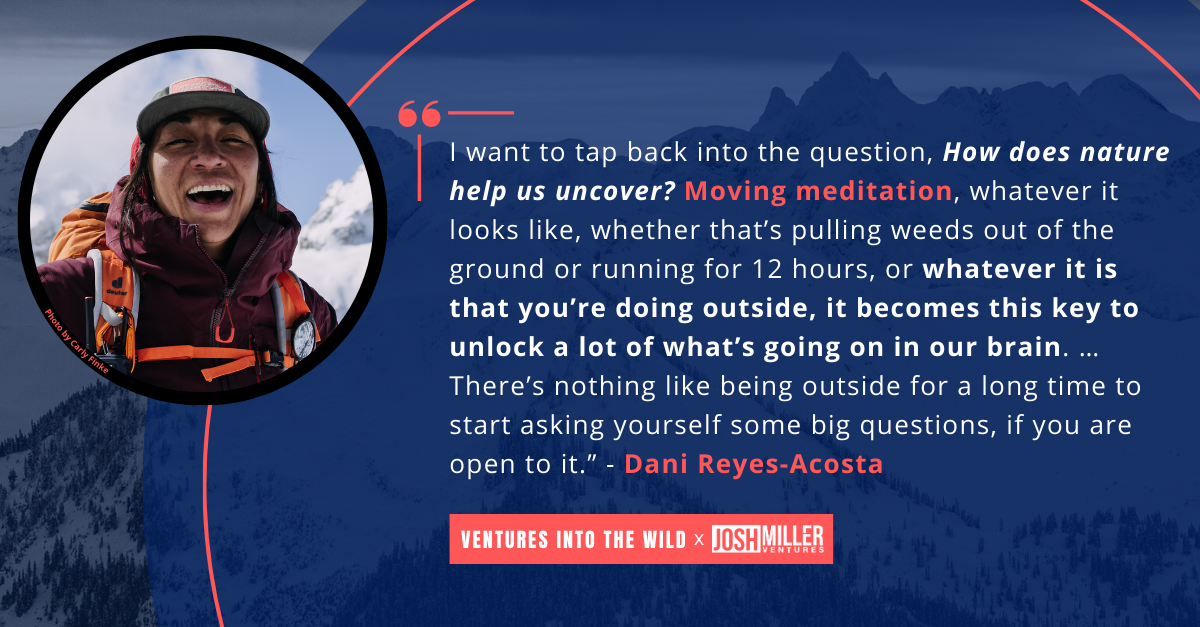
“I want to tap back into the question, How does nature help us uncover?” Dani said. “Moving meditation, whatever it looks like, whether that’s pulling weeds out of the ground or running for 12 hours, or whatever it is that you’re doing outside, it becomes this key to unlock a lot of what’s going on in our brain. … There’s nothing like being outside for a long time to start asking yourself some big questions, if you are open to it.”
After a bite of orange, Dani continued, talking about the months she spent back in California as her mom underwent cancer treatment. She kept finding herself trying to “stay busy,” something I’d experienced traveling back to places where my brain didn’t necessarily want to revisit past experiences and memories. “I was like, I might lose my mom, I should spend time with her. And it was really interesting to see how my brain wanted to go and do these different things to maintain busyness,” she said. “Because the stillness of being in that space was one that cut closest to the heart. It was so difficult. And learning to embrace that stillness was I think one of the things that was most difficult, but rewarding. It’s nice to be still.”
Before we moved on from the topic of covering, Dani said, “The title of your talk struck such a resonant note with me, this idea of The Courage to Uncover who you are is something that I think for so many people feels really intimidating. On one hand, I think to myself, these are folks that choose to do difficult things every day, whether that's going for a long bike ride, or ski tour or spending hours in the garden. And I have to ask myself, if we can have the courage to do that, don't we really have the courage to ask ourselves some questions about who we want to be and the world we want to live in? I know we're all capable of it. We just have to try and expect often that we will fail, but failing isn't the end all and be all, it's just a step to uncovering.”
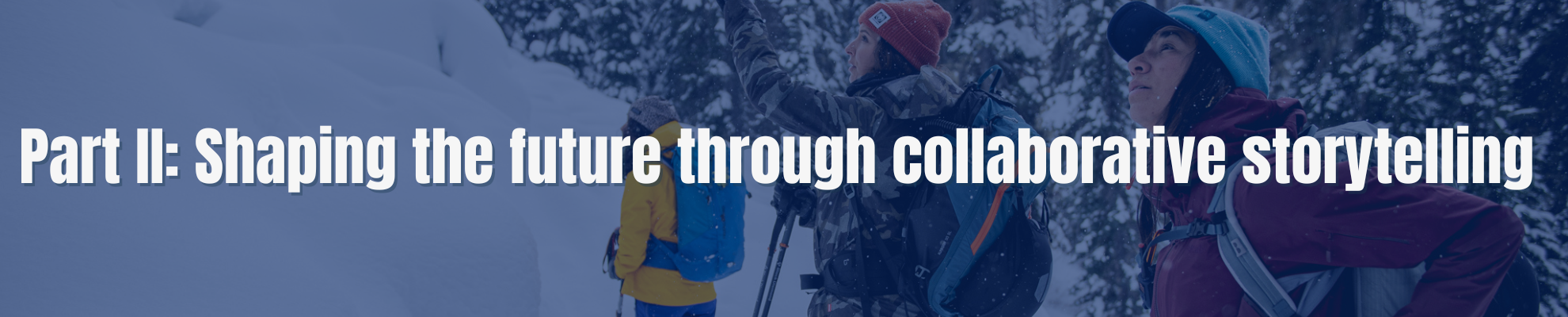
The Well Worn Life documentary that features Dani gives a clear snapshot for how she moves through the world. “In many ways, a lot of my activities outside are rooted in moving through landscape to see how I fit into it… I don’t just belong, I am part of the landscape,” she says in the film. Dani’s focus on relationships carries through, from how she cultivates teams to the types of stories she works to tell through her company Afuera Productions.
Their current project, OUTLIER: COMMON, is the second installment of a series that features three women, athlete-scientist Nina Aragon, athlete-community builder Vanessa Chavarriaga Posada, and athlete-filmmaker Dani Reyes-Acosta. The series uses their snow adventures as a lens through which to explore the evolution and growth of their relationships with the mountains, each other, and themselves. It reframes how women—particularly women of color—are portrayed in action sports media.
Like it did for many of us, the disruption caused by COVID-19 made Dani question her work. “I wanted something more,” she said. “Rooted in this desire to dream of something bigger and better. Something that didn’t just benefit me but allowed all of us to dream… ultimately the OUTLIER series allows us that space of dreaming, no matter what identity you hold.”

The creation of this series is “an understanding that living in between different identities and communities and spaces - in the gray area - can be a great thing because when you’re neither in one or the other, you’re a bridge,” Dani shared. “If you allow yourself to be a bridge. I realized I was between communities, between identities, between languages.”
“I don’t want to live in a world where I am afraid to walk down the street, or of the questions a doctor might ask me, or because of who I am as a person,” Dani explains. At its core, the OUTLIER films are about the collective journey. “This [series] is something that is rooted in our rights as humans. What do we want as a society? The visuals of the big mountains give us space to dream and imagine.
My goal is to not just to flip the script on who we are in the mountains, but also like, what is our relationship to these spaces because so many of the stories that we’ve been fed - ever since mountain stories became a thing - are about domination, rather than cooperation.”
Following the behind-the-scenes on Instagram, as Dani, Nina, Vanessa and the production crew have traveled to create the film has been fun and informative. From a beautiful sunrise or waterfall, to travel problems due to winter weather, it’s all part of expanding what’s possible. “If episode one, OUTLIER: TRUST, is about understanding the journey of who we are, and trusting the process and embracing it or not, then episode two, OUTLIER: COMMON, really digs deep into [the character’s] individual journeys and how they show up in community,” Dani said. The film will encourage viewers to ask, “How do you show up for yourself? How do you show up for others, even when you’re surrounded by chaos? Each of us are learning, both separately and together, that our tenacity and desire to move forward is grounded, not in just our individual goals, but is very much rooted in the support of those around us. It’s 100% reciprocal.”

If you’ve followed my own adventures, you know as a photographer that my exploration and experiences in nature are often depicted through photography. My relationship with my camera is one I continue to reexamine over time as my motivations and dreams evolve. For the OUTLIER series, Dani plays a dual role, on one hand, serving as Creative Director and Producer, and on the other, as a subject of the films. Dani explained, “It’s been very interesting, and I think it ties back into your question about covering and identities and how we move through those spaces with different identities depending on what’s needed at the moment. It’s not been easy… you have to be willing to have some hard conversations, with yourself and with other people.”
Again, the theme of connectivity arose. Working with mentors including story advisor Monica Medellin and visual advisor Corey Robinson on the series spurred conversations focused on self-awareness, commitment, and ways of viewing things from both in-front of and behind the lens.
“In a nutshell,” she said, “It’s been mentally and emotionally exhausting. [It also] Cultivated better communications habits, better expectations, and in so many ways helped me think about how I’m bringing the right people onto this project.”
From the creative team they collaborated with to film in the Tetons (shout out to Charlotte Percle, Sam Davies, Carly Finke, Sophia Schwartz) who set a new bar for creating a supportive, safe space, to seeing how people with different racial backgrounds and lived experiences play a role in supporting the vision of OUTLIER, Dani said that “what I needed are people who are actively checking in with themselves, and who are invested in not just doing beautiful work, but also in seeing others thrive.”
As an example of that belief, when Director of Photography Sam Davies - a cishet White man - experienced travel delays flying from Dublin, Ireland to Jackson Hole, Wyoming to meet the team, Dani said, “I just reminded him, tomorrow is a scouting day. I just need you to focus on getting on the next flight… I want someone who is an empathy driven leader that is excited about creating art and space. Sam, I want you, it’s gonna be ok.”
If OUTLIER: TRUST is any indication, the next episode will be compelling and vivid in its depiction of these women’s ventures into the wild. I reached out to Dani before seeing that the second installment was underway, and then became one of the first investors when the crowdfunding campaign launched last month. These stories and the expansive approach they are taking is important, and I’m excited to see what they create together!
Like this series is meant to explore diverse experiences and what’s possible, OUTLIER is “meant to be a way to engage with each other and have bigger conversations that oftentimes don't happen when we keep the same insular social circles,” said Dani. “I think what all three of us in COMMON are really excited about is that this can be a tool and a platform for all of us to grow and connect together. So I hope people join us - this is going to be fun!”
How you can support OUTLIER
Dani and the OUTLIER team plan to finish filming in early spring, and hope to host a screening in fall 2024 once post-production wraps up. They are ¼ of the way to their $26,000 crowdfunding campaign goal that will cover production costs, with various benefits for people who contribute including the BTS footage on IG, access to the screening this fall, and more based on the giving level. The campaign’s current fundraising deadline is April 4, 2024. Click here to learn more.
Photos courtesy of Dani Reyes-Acosta, taken by Carly Finke and Guy Fattal.


